

Last week Barna released new research results from their State of the Church initiative, and there are some interesting indicators to consider:
“We keep asking whether young people are coming back or falling away, as if it’s one tide moving in one direction,” says Barna’s vice president of research, Daniel Copeland. “For nearly half, nothing has changed. The real story isn’t the average, it’s who’s stirring at the edges and what they are looking for.”
At face-value, there are important findings for pastors and denominational leaders to consider:
- First, under the heading of "burying the lede," just 34% of respondants report attending church more often while 45% report no change in attendance and 21% report attending less often. This may indicate some increase in church attendance among Gen Z...but not much. This puts a damper on recent popular reporting (including by Barna itself) that Gen Z is returning to church in significant numbers. Others have already pointed out this is likely over-stated and this report seems to support that caution.
- Second, this data adds evidence for the growing gender gap in church attendance. Among respondants, 41% of the men reported increased church attendance compared to just 27% of women. Meanwhile, 25% of women reported decreased attendance compared to just 18% of men. In other words, consistent with other findings, the church is losing women faster than men.
- Among those adults who are attending church more often, 41% are Black (41%) and 36% are Hispanic.
- Among those who cite "spiritual reasons" for attending church, the response that tops the list is "To pray" at 45%.
For what its worth, at The Oceanside Sanctuary most of this rings true. We aren't seeing fewer women engaged, but we definitely are seeing more men, more young parents in their 30s, and (perhaps more suprisingly given that we are a progressive church) more people of color. And we are hearing people express more interest in spiritual practices, like prayer. If you're a pastor, your mileage may vary, but my sense is that people are searching for grounding in a world that feels more chaotic.
But I'm especially interested in the assumptions behind not only the survey questions but the way the results are presented. For example, the "at-a-glance" bulleted summary of the article states:
Prayer tops the list of reasons young adults give for showing up, ahead of every other spiritual reason surveyed.
Technically, that's true. But 45% isn't even a majority. The bigger takeaway here, I think, is the plurality of reasons people have given.
Have a look:
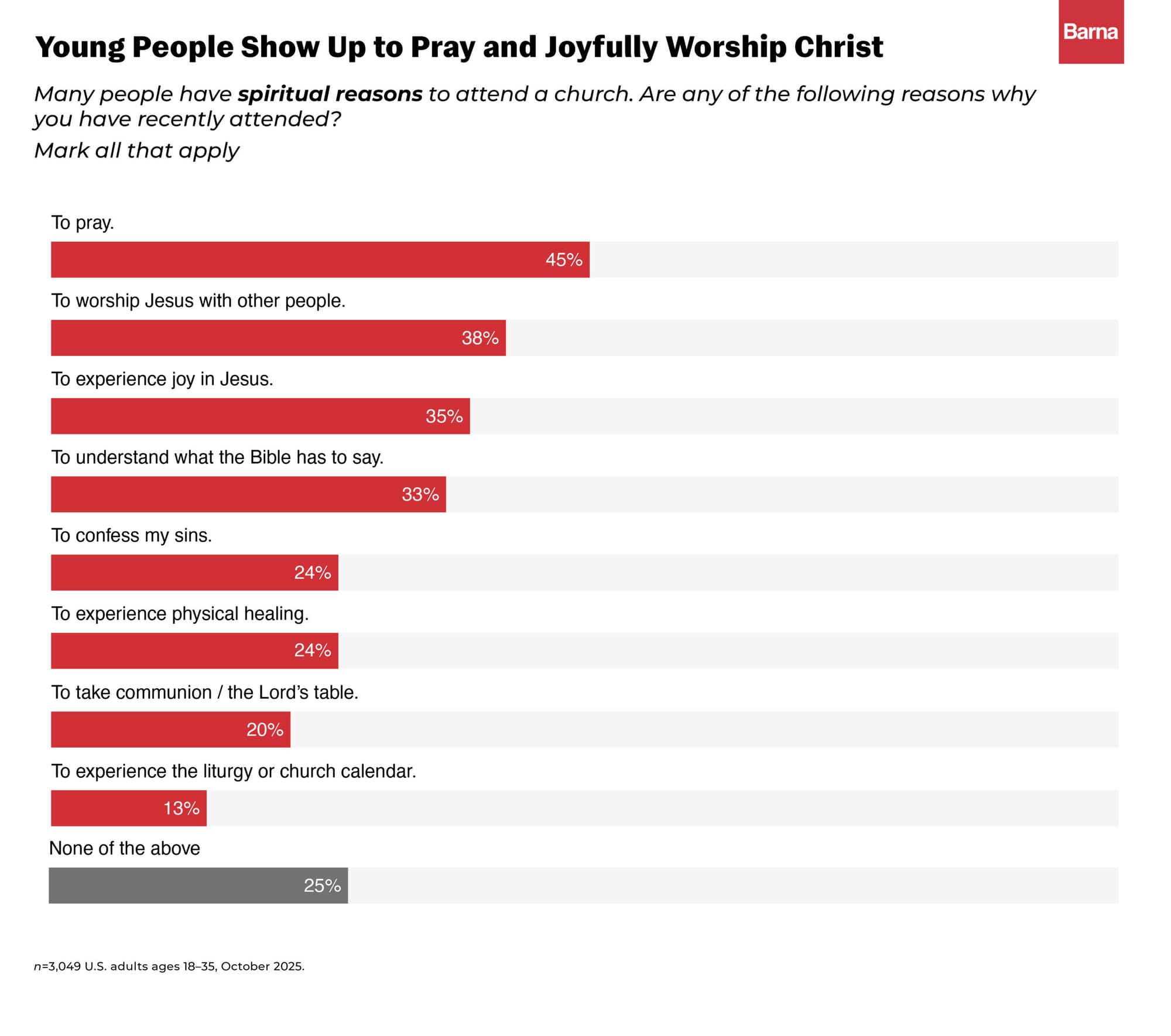
Respondents were obviously allowed to select multiple choices. What makes this interesting is that when a group of 18-35 year-old church attendees were given the opportunity to identify all their reasons for attending church, only 38% included "To worship Jesus with other people." That strikes me as surprisingly low. Meanwhile, 25% said, "Nah, I don't go to church for any of these reasons." That seems very high to me.
This tells me a couple things: 1) There are lots of reasons these people go to church beyond the eight options they were given, and 2) Whether intentionally or not, Barna’s categories construct a particular framing for what counts as a “spiritual” reason for attending church. Notice how the question is phrased:
Many people have spiritual reasons to attend church. Are any of the following reasons why you have recently attended?
Are these really the only "spiritual" reasons for attending church? Would, say, attending with one's family or friends in order to experience a meaningful expression of belonging not be a "spiritual" reason? Would, participation in a community of mutual aid not be validly spritual? What exactly is and is not "spiritual"? More importantly, how do our judgments of those reasons create different levels of access to the genuine goods of a religious community?
The Barna Group has long been critisized for conservative biases. That doesn't mean their data isn't sometimes revealing, but it should always be handled with care.
In my experience, people attend church for an increasingly diverse set of reasons and practice their faith in increasingly diverse ways from the standpoint of increasingly diverse theological imaginations. To me, that's the real story of this survey (however biased it might be): Christianity is becoming more and more pluralistic.
And that, is a good thing that deserves more precise empirical attention.
